
Qeasy Cloud
Get Started

AI-Driven · Smart Replenishment · Data-Backed Decisions

Move replenishment beyond manual exports + Excel formulas to traceable decisions

An AI-powered replenishment decision platform for small and mid-sized e-commerce and retail businesses. Sales, inventory, in-transit and product master data converge into a single fact foundation, with two built-in business pipelines: 2C self-operated weekly replenishment and office-supply omnichannel replenishment. AI agents guide business users through data fetching, formula computation, plan adjustment and replenishment order generation — every suggestion backed by data, formulas and reports, fully traceable.

Data sources
7 个

Core Jikeyun APIs

Replenishment pipelines
2 条

2C weekly + office omnichannel

Registered agents
3 个

General + fetch + compute

Three business scenarios

Data Foundation, AI Agents and Smart Replenishment at a Glance

What the platform does, distilled into three visual scenario maps — use the buttons to jump to the matching chapter.

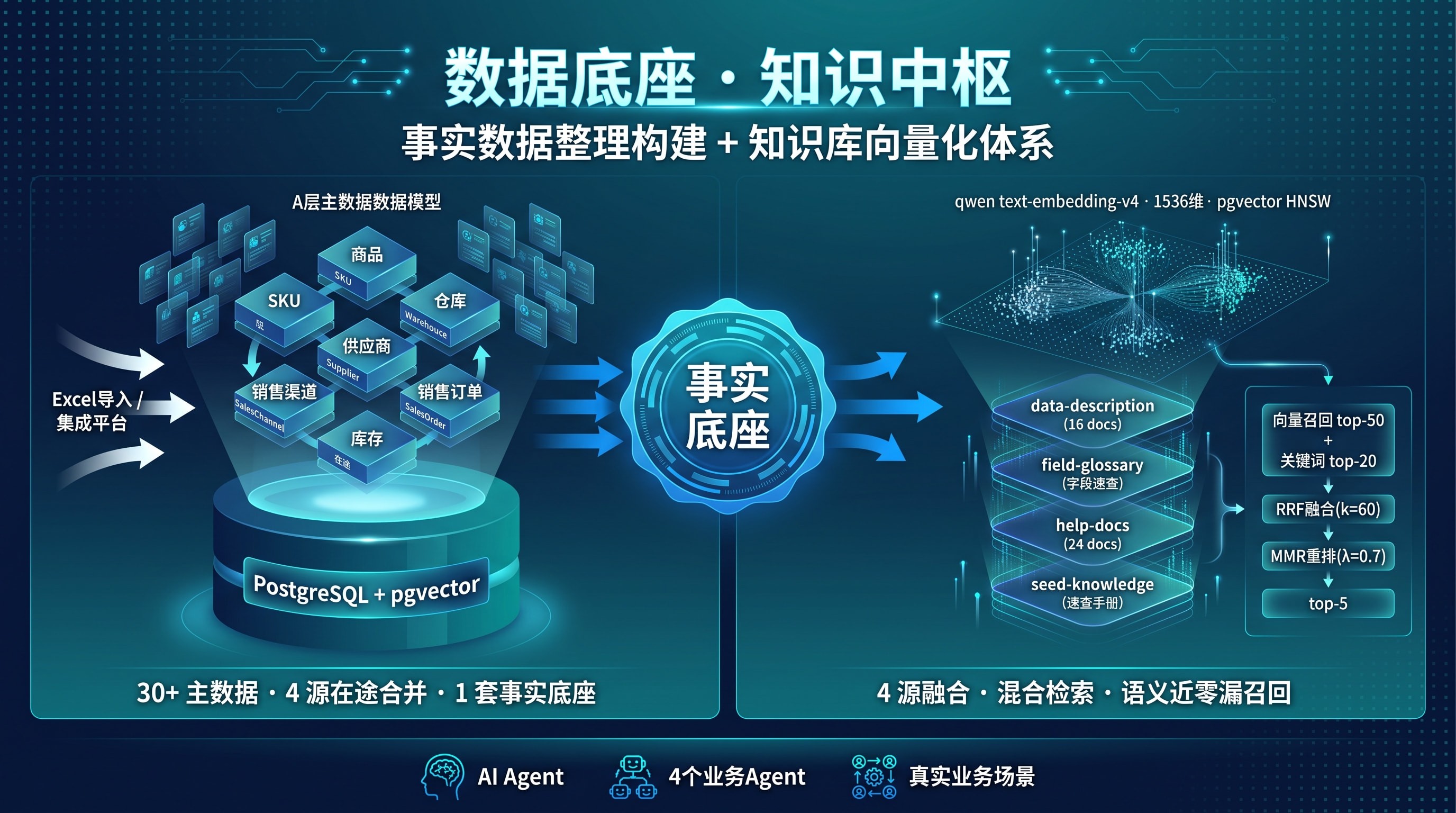
  • Data foundation and knowledge hub: sales, inventory, in-transit and product master data settling into a fact foundation

    Data Foundation · Knowledge Hub

    Sales, inventory, in-transit and product master data settle into one fact foundation; the knowledge base retrieves with 1536-dimension hybrid vectors so AI truly understands business data.

    Explore the data foundation
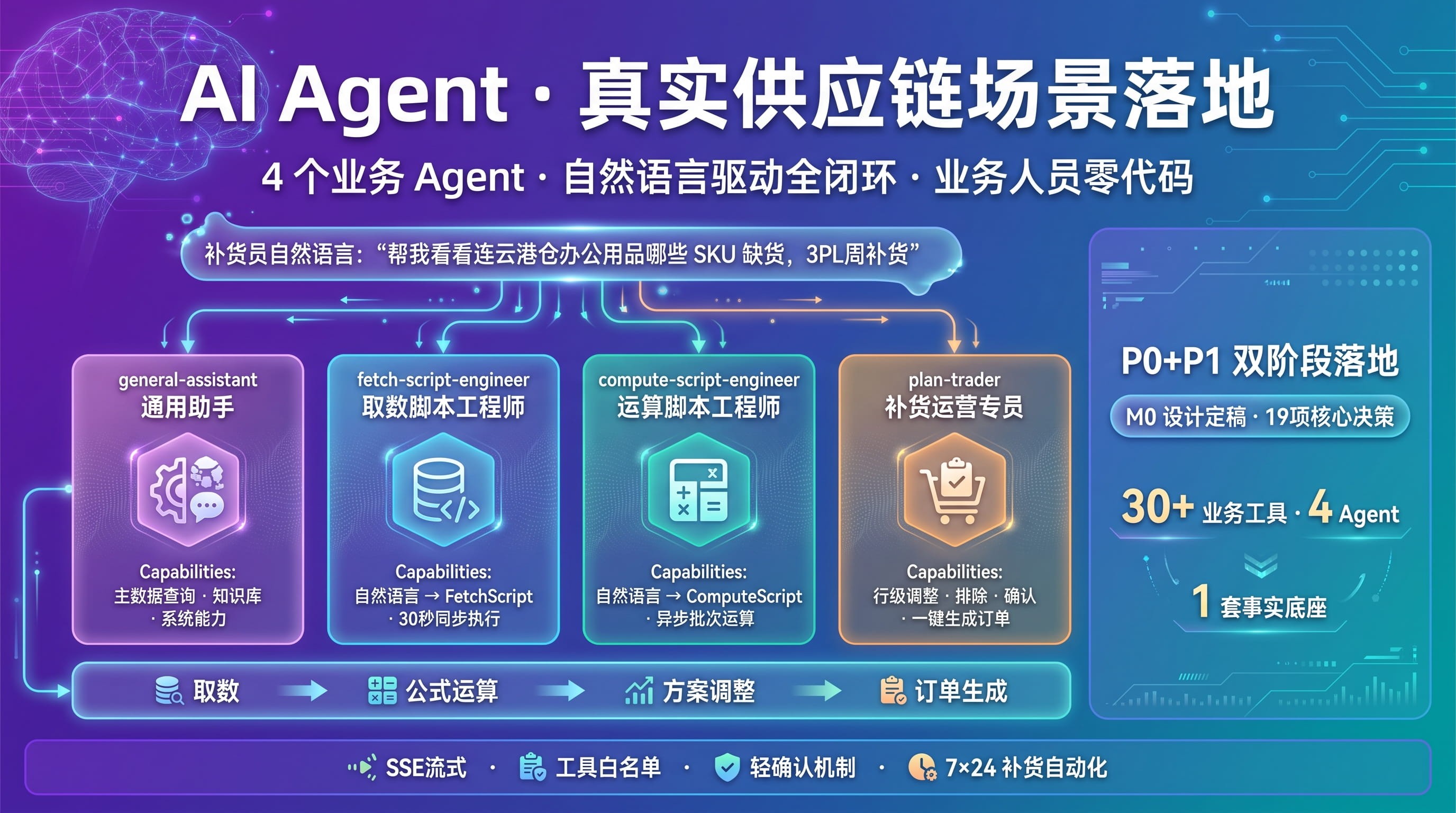
  • AI agents assisting supply-chain replenishment collaboration

    AI Agents · Zero Code for Business Users

    The general assistant, fetch engineer and compute engineer collaborate around real supply-chain work. Business users describe goals in natural language; agents handle fetching, computing, plan adjustments and order generation.

    See how AI works
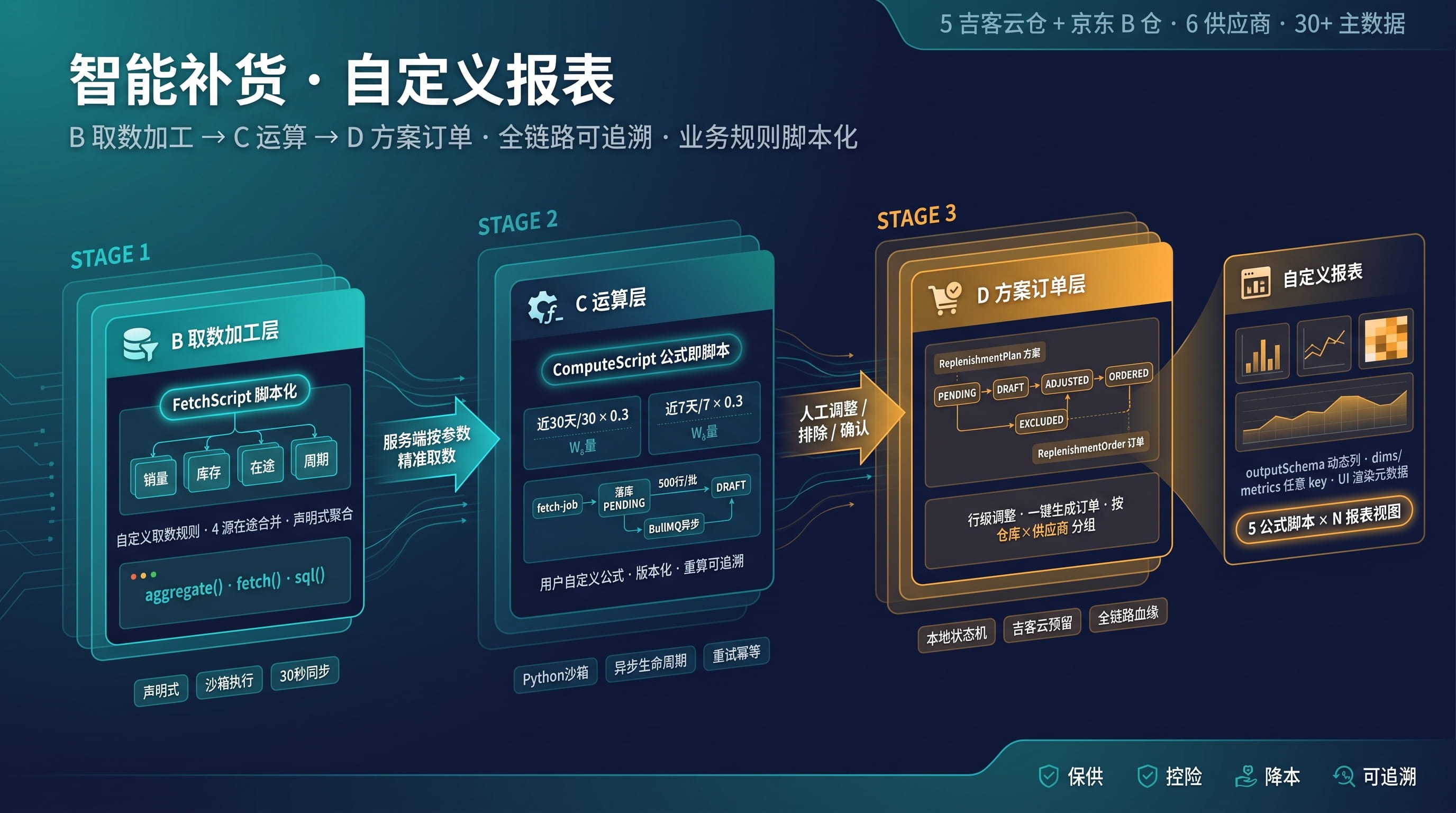
  • Smart replenishment end-to-end reports and customizable replenishment plans

    Smart Replenishment · Custom Reports

    Fetching, processing, computing, planning and ordering — traceable end to end. Replenishment rules are scripted with tunable coefficients; every suggestion traces back to concrete data and formulas.

    See the full pipeline
Platform capabilities

Four Cooperating Layers — A / B / C / D — Keep Data, Rules and Results Traceable

A three-tier architecture (A data detail → B fetch & process → C compute) plus D plans & orders: every replenishment suggestion traces line by line back to its data, formula and adjustment history.

Data Detail Layer

The fact foundation: data from upstream APIs, Excel imports and manual upkeep is persisted under unified primary keys.

  • Master data: warehouses, sales channels, suppliers, products, categories, business scenarios
  • Business documents: purchase orders, sales orders, inbound/outbound orders, EAS transfer orders, JD B-warehouse inventory
  • Two-way sync with Jikeyun open APIs, plus manual Excel adapter imports

Fetch & Process Layer

Configuration-first: business users define fetch rules that run instantly in the sandbox, producing dimension-aligned detail tables.

  • Declarative filtering, aggregation, time windows, multi-source in-transit merging, master-data snapshots
  • Synchronous execution returning within 30s — no ad-hoc async queues
  • Output doubles as dimension-analysis tables: server-side pagination + client-side filter / sort / search

Compute Layer

Compute scripts consume B-layer output: primary fetch persisted → async BullMQ batch computation → row-level state-machine closure.

  • Fetch results are chunked into PENDING rows and fanned out at 500 rows per batch
  • Inside the compute sandbox, fetch can be called again (full fetch permissions, read-only SQL)
  • Plan-level 6 states + row-level 7 states (PENDING / DRAFT / ADJUSTED / EXCLUDED / CONFIRMED / ORDERED / FAILED)

Plans & Orders

Computation results become executable replenishment plans, then split into replenishment orders by caliber.

  • Plan templates: default parameters saved as named plans; recomputation produces versioned batches with lineage
  • Row-level manual adjustments: tune quantity / exclude / confirm; no unsettled rows allowed before confirmation
  • Replenishment orders split by orderKey; suggestion snapshots embedded in order lines for two-way traceability
Replenishment scenarios

Two Business Pipelines in Production

Business scenarios are freely categorized (no enum binding); new scenarios require no schema changes.

2C Self-Operated Weekly Replenishment

2C
Channel
2C sales business unit
Cadence
Weekly
Shape
Formula-driven (ROUNDUP / INT safeguards)
  • Multi-window weighted sales: last 7 / 30 days + yesterday + 3-month daily average, weighted 0.3 / 0.3 / 0.2 / 0.2
  • Office supplies target the Lianyungang warehouse: longer windows + INT risk control
  • Output by product × warehouse, with detail fields aligned to the plan

Office-Supply Omnichannel Replenishment

OC
Channel
JD online 2P + offline 2BCG
Cadence
3 times a month
Shape
Semi-manual (exclusion method + turnover-day constraints)
  • Remaining arrivals = total arrivals − arrived; the exclusion method removes anomalies
  • Replenish by supplier × warehouse turnover days; JD items with orderable turnover > 90 days are not scheduled
  • Coexists with manual arrival-quantity backfill; final results enter the plan loop
Data integration

7 Core Jikeyun APIs + Manual Ledgers

Built on Qeasy's connectivity to 500+ mainstream systems — Kingdee, Yonyou, SAP, Jushuitan, Jikeyun, Mabang and more across ERP, e-commerce and supply chain. The replenishment scenarios showcased here focus on Jikeyun open-platform APIs plus manual ledger adapters.

The 7 core Jikeyun integration APIs
Data domainAPIPurpose
Warehouseserp.warehouse.getMaster data / multi-warehouse calibers
Product categorieserp.goodscate.getMaster data / full replacement
Productserp.storage.goodslistMaster data / products + SKUs
Supplierserp.vend.getMaster data / turnover dictionary
Sales channelserp.sales.getMaster data / channel dictionary
Purchase orderserp.purch.getOne source of in-transit orders
Real-time inventoryerp.stockquantity.getAvailable warehouse stock
Reports & dimension analysis

Fetch Output = Dimension-Analysis Tables

Fetch scripts emit dimension-aligned structured detail: server-side pagination with client-side search, filter and sort. Previews and small-data debugging run as synchronous dryRuns; production computation runs on the async BullMQ pipeline.

  • Fetch output = dimension-analysis tables: server-side pagination + client-side search / filter / sort
  • Previews and small-data debugging use synchronous dryRun; production runs go through async BullMQ
  • No general-purpose report builder; no drag-and-drop custom reports at this layer
AI capabilities

3 Registered AI Agents · Vector-Retrieval Knowledge Base

Built on the platform agent runtime, every write action goes through the existing script + execution chain, with a business-language confirmation before triggers. Agent retrieval relies on a knowledge base with hybrid vector + keyword recall, RRF fusion and MMR re-ranking — no invented abstraction layers.

general-assistant

General Assistant

Master data / knowledge base / system capability queries

Read-only tools; no write operations

fetch-script-engineer

Fetch Script Engineer

Atomic fetching with FetchScript

One business-language confirmation before a trial run

compute-script-engineer

Compute Script Engineer

Batch computation with ComputeScript + replenishment plan templates

One business-language confirmation before submitting a plan

System foundation

Sandbox Isolation · Auditing · Async Controls

Security and observability are built into the platform baseline, not patched in afterwards.

Script sandbox

Layers B/C share one sandbox: dual-layer isolation with child_process + isolated-vm; fetch returns synchronously within 30s, compute runs in async batches.

Audit logging

Results / parameters / row counts / durations are written to a shared audit table — business rows are not materialized, keeping traceability without storage bloat.

Async controls

BullMQ queues + 200k-row circuit breaker + 500-row batch fan-out; failed rows can be retried at plan level.

Multi-tenant extension

Single-tenant today; extension seams such as SupplierTenantBinding are reserved for future business needs.

FAQ

What Customers Ask Most

Which data sources does the platform integrate?

Primarily the 7 core Jikeyun open-platform APIs (warehouses / products / categories / suppliers / sales channels / purchase orders / real-time inventory); Excel adapters import custom raw tables.

How are replenishment suggestions computed?

Layer B aligns layer-A details into consumable structures; layer-C compute scripts consume B's output into PENDING rows; BullMQ async batches produce suggestions, which then go through row-level confirmation → order splitting → orders.

Do the AI agents run unattended?

Three agents are registered (general assistant + fetch script engineer + compute script engineer); every write action requires one business-language confirmation and goes through the existing script and execution chain.

Can more ERPs be integrated?

Yes. The Qeasy data integration platform has accumulated connectivity to 500+ mainstream systems — Kingdee, Yonyou, SAP, Jushuitan, Jikeyun, Mabang and more across ERP, e-commerce and supply chain. Each project confirms scope and implementation around business goals, API contracts, field mapping and data calibers.

Is the data traceable?

Computation results can be traced row by row: dimensions, raw variables, formulas and adjustment records are all persisted; plan recomputation produces versioned batches with parentPlanId lineage preserved.

Redefine Replenishment Decisions with Data and Scripts

Register to get started, or contact Guangdong Qingyiyun Software Technology Co., Ltd. to learn about onboarding.

Qeasy AI Agent · Smart Replenishment Platform | Qeasy Cloud